Tuesday, 29 June 2010

MATANIA ILLUSTRATION INTEGRATED INTO MICKEY MOUSE WEEKLY COVER


In his memoirs published in a fanzine of the Britain-based Association of Comic Enthusiasts (ACE) years ago, British comics artist Basil Reynolds, who had also worked in editorial capacity in Britain's Mickey Mouse Weekly in the post-World War 2 years, recounts how he had once visited famous illustrator Fortunio Matania (1881-1963) and borrowed a b&w original of one of his illustrations ("a jousting scene") to use on a cover of MMW ("as the large opening pictıre of a Disney strip") in colors. Above scan is of the cover of no. 592 (dated Sept. 15th, 1951) of MMW, which must obviously be the cover in question.
Big thanks to John Wigmans for providing me the Reynolds memoirs...

Sunday, 27 June 2010

SOCCER-THEMED BRITISH DONALD DUCK STRIP (1948)


Above scan is of the cover of no. 478 (dated Nov. 13th, 1948) of Britain's Mickey Mouse comics magazine, featuring a British-made soccer-themed Donald Duck strip.

Saturday, 26 June 2010

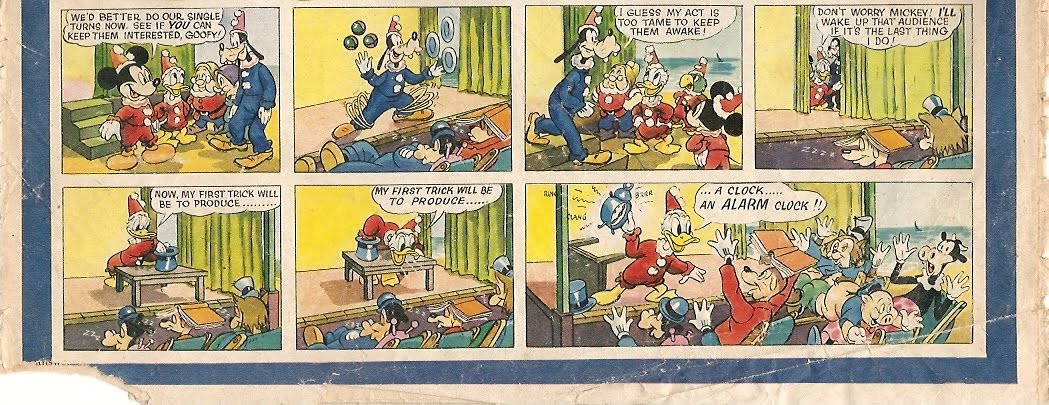
BRITISH-MADE DONALD DUCK AND GOOFY STRIPS FROM 1948


I had covered the evolution of the covers of Britain's Mickey Mouse magazine in the aftermath of the 2nd World War in my post on May 1st. In that post, I had noted that British-made strips had become the norm by 1949. Recently, I've come across an earlier example from 1948: no. 470 (dated July 24th, 1948) whose scan is above. Incidentally, that there was apparently something wrong with the publication of this strip: as far as I can fathom, the title 'Famous Last Words!' is unrelated to the plot..
The same issue also includes a British-made Goofy strip:

Sunday, 2 May 2010

'CUBBY AND TUBBY'


Britain's Mickey Mouse comics magazine reverted back to weekly period in 1950 and was re-retitled as Mickey Mouse Weekly as it was titled from its inception from 1936 till 1941. Two additional British-made Disneyic gag comics series were featured in the revitalized magazine, alongside British-made cover gags and Pinocchio gags which had started the year before and material of US origin,: the color 'Cubby and Tubby' and the black&white 'Bongo the Wonder Bear'. Of these, 'Cubby and Tubby' is of great interest as it is, to a large degree, a British creation.

The inspiration behind 'Cubby and Tubby' appears to be two bear cubs, one of whose is named as Cuthbert, which appear in a Li'l Wolf comics from the US Walt Disney's Comics & Stories no. 52 (dated Jan. 1945): And the inspiration for Cuthbert and his sibling appears to be the two bear cubs from the Disney black&white cartoon short The Bears and Bees (1932).

In any case, when 'Cubby and Tubby' first appeared as a single-row strip spread over the bottom rim (soon, the strip would be shifted to the top rim) of the two central pages in no. 512 (scans at the top of this post), both of the cubs were of brown color, just like the bear cub friends of Li'l Wolf in WDC&S. Eventually, one of them began to sport orange fur, as in the below scans from no. 525: The British artist(s?) responsible for 'Cubby and Tubby' were initially careless in differentiating the cubs. Note that in the above gag, the brown cub is named as Tubby. However, in subsequent gags, the name Cubby would stick to the brown one!

'Cubby and Tubby' has pleasant artwork while the humor in the gags is not always as qualified. It would be one of the longer running British-made gag series and continue till 1953.

Saturday, 1 May 2010

BRITISH-MADE COVER GAGS IN MICKEY MOUSE COMICS MAGAZINE (1948-49)


For the past few weeks, I have been covering British-made comics material published in Mickey Mouse in the late 1940s. I round up this coverage with today's post on gags which appeared on the covers of this British comics magazine. Initially in the post-war (as well as war-time) era, the covers of Mickey Mouse (or Mickey Mouse Weekly as it was titled till 1941) featured American strip material in irregularly re-formatted columns/rows, with the remaining cover space filled up with illustrations by British artists. In 1948, the cover layout was standardized with American-origin strip material taking up the lower 1/3rd of the cover and British illustrations taking up the remaining space. Initially, the British illustrations were unrelated to the accompanying American strips in terms of content, like in the above scan of no. 464 whose accompanying strip was a Li'l Wolf comics from US Walt Disney's Comics & Stories redrawn and reformatted as a strip. Eventually, the British illustrations began to take their cue from the strips, as in the below scan(s) from no. 472 (whose strip is an abridged -missing 2 panels from the original- version of an American Mickey Mouse Sunday strip):
In the above example, the British illustration is related to the strip in the sense of featuring the same set of characters in the same setting, but is nevertheless independent of it in the last analysis in terms of plot. By 1949, the relation began to go further than that with the British-made illustrations functioning as if they were enlarged introductory panels ('splash panel') of the American-origin strips in the sense of plot as well, as in the below example from 491 (whose stip is again an abridged version an American Mickey Mouse Sunday strip):

By this time, British-made strips themselves also had began to appear occasionally, an early example being the cover of no. 488 whose scan I had posted at the bottom of my below post on April 9th. By the summer of that year, such all-British covers would become the norm. The below scans are from no's 495, 498 and 500:


Monday, 26 April 2010

BRITISH-MADE PINOCCHIO GAG COMICS


The longest-running British-made gag comics series to start in Britain's Mickey Mouse comics magazine would be 'Pinocchio'. It started in no. 495 (dated July 9th, 1949) as a single-row strip spread over the top rims of the two central pages (scan above is broken into two due to limitations of my scanner) after the end of 'The Reluctant Dragon' strip. Soon, it would be reformatted as in the below scan from no. 500:

Later, it would be reformatted once again, this time as two-columns, and continue until 1953.
In 1975, another apparently British-made Pinocchio gag comics series would appear in The Wonderful World of Disney magazine under the title of 'The Playful Pranks of Pinocchio'. The Wonderful World of Disney Annual 1977 also included an installement of 'The Playful Pranks of Pinocchio', whose original art scans are below:

Sunday, 25 April 2010

THE RELUCTANT DRAGON REDRAWN (BY BASIL REYNOLDS?)


'The Reluctant Dragon' comic strip which was serialized in Britain's Mickey Mouse comics magazine in 1949 as a single-row strip spread over the top rims of two central pages was a redrawn version of the comics story published as a "one-shot" comics in the US in 1941 (which itself was an adaptation of the feature-length Disney movie from the same year). The above scan (broken into two due to the constraints of my scanner) is of the first installment of the British version (from no. 488) and below images are of the first three pages of the original American version:
The British version, which, in my opinion, is actually an improvement over the American original by Irvin Tripp, was probably the work of Basil Reynolds.

Friday, 23 April 2010

BRITISH-MADE FIGARO AND PEDRO THE AIRPLANE GAG COMICS (1949)

Besides the 'Danny the Lamb' strip, two other British-made gag comics published in Britain's Mickey Mouse once this comics magazine was re-enlarged to 12 pages beginning with no. 499 (dated Sept. 3rd, 1949) were a Figaro strip and 'The Adventures of Little Pedro', both of which were apparently short-lived. Figaro had debutted in the animated feature Pinocchio (1940) as the cat of the wooden-boy's father Gepetto. The Figaro strip in Mickey Mouse (the above scan is from no. 499 and the below ones from 500 and 505) had come at the tail end of a resurgence of the popularity of the feline character when he had starred in a series of six cartoon shorts (as Minnie's cat) between 1943-49 (most of these were adapted to comics or illustrated text story formats published in the US Walt Disney's Comics & Stories). Decades later, he would also star in a series of one-page gag comics in continental Europe between 1999-2001.Pedro the Airplane was the star of one of the animation segments of the feature-length compilation movie Saludos Amigos (1943).In the same year as 'The Adventures of Little Pedro' was published in Mickey Mouse (the above scans are from no. 499, 500 and 500), he had also co-starred with Dumbo the Flying Elephant in a 9-pages comics published in no. 234 of Walt Disney's Comics & Stories. However, he had earlier appeared in one cover of the British Mickey Mouse (no. 398, dated Nov. 6th, 1945), making his first-ever appearance in the cover of a comics magazine anywhere in the world:

As a bonus, I also post a Pedro cover from Turkey, the no. 6 (dated May 12th, 1958) of the 'special issue' series of Vak Vak Kardeş:

Sunday, 11 April 2010

'DOC'S WOODLAND WONDERS' (1948-49)


'Doc's Woodland Wonders' was a nature-themed strip published in Britain's Mickey Mouse comics magazine between 1948-49. Basil Reynolds (see the below post for more on him) was the main artist. It debutted in no. 462 (dated April 3rd, 1948) as a b&w strip but was soon moved to the color central pages, replacing the non-Disneyic comic strip 'The Adventures of Tom Sawyer', and initially featured the Seven Dwarfs and occasionally some other Disney characters. Eventually, it was shifted first to the b&w pages and then, with no. 483, reverted back to color in the bottom portion of the last page (back cover) but the Disney characters began to be omitted from the strip henceforth even though the name of Doc (of the Seven Dwarfs) remained in the title. It lasted till (including) no. 498. The scans in this post are from no.'s 464 (above), 465, 467, 468, 470, 472, 475, 478 and 482.


Between 1953-54, Reynolds did another nature-themed series for Mickey Mouse Weekly titled 'True Life Adventures'.