Wednesday, 17 February 2010

MEXICAN UGLY DUCKLING COLORING BOOK (1945)


This Mexican Ugly Duckling coloring book from 1945, published by Endiciones Modernas, was recently sold at ebay for the opening price of 10 US dlrs.

Friday, 12 February 2010

OBSCURE MMW COVER LOOK-ALIKE ARTWORK


The above artwork was recently auctioned at ebay and was eventually sold for a winning bid of 90 British pounds. The overall design obviously recalls the pre-war covers of Britain's Mickey Mouse Weekly, which are known to be the work of British artist Wilfred Haughton, but not only is the artwork signed by one "H.Horsley", the actual depiction of the figures is awkwardly 'distorted', which, in my tentative opinion, makes it unlikely that it was intended for MMW. The ebay seller speculated it might have been a sketch for Haughton to finish up, but I suspect this might have been a private re-working of MMW covers for unknown motives.

Saturday, 30 January 2010

"THEY'RE BOMBING BERLIN!"


The above panel is from the Donald Duck Sunday newspaper gag comics of June 24th, 1945. This particular Sunday has never been reprinted in the US; below is a scan of its reprint from Britain's Mickey Mouse magazine no. 401 (Nov. 17th, 1945):

MISSING PANELS IN MICKEY SUNDAY REPRINT IN WDC


When Mickey Mouse Sunday newspaper comics were reprinted in Walt Disney's Comics & Stories magazine, they were re-formatted to fit the page layout and some panels from the original were often omitted in the process. For example, the above reprint of the Nov. 1st, 1942 Sunday in WDC&S no. 38 (Nov. 1943) is missing a total of 5 panels from the 12 panels of the original Sunday version.
Below are scans of the missing panels, as reprinted in Britain's Mickey Mouse magazine (wartime bi-weekly edition of Mickey Mouse Weekly) no. 399 (Oct. 20, 1945):

Note that only the third panel in the above scan is available in the WDC&S reprint..

..and only the central panel in the above scan.
The fifth missing panel is this reaction shot of Mickey, whose original place was just before the last panel:

Tuesday, 26 January 2010

FIRST DISNEY COVER IN TURKEY AND OTHER DISNEY COVERS OF AFACAN (2ND SERIES)


Mickey Mouse gag panels had appeared on the covers of several issues of the first series of Turkish children's weekly Afacan (1932-34) but since that publication was of tabloid size, the said panels took up a small portion of the covers' area which they shared with other, non-Disneyic items and thus were not cover illustrations in the conventional sense. The first proper Disney cover of a Turkish publication came with the no. 3, dated Dec. 6th, 1934, of Afacan's 2nd series, whose scan is above. In the central illustration, Mickey is drumming to herald the coming of the holy fasting month of Ramadan. The artist is unknown. The smaller figures at the top of the cover are apparently taken from yet-unidentifed foreign sources (the Horace in bondage figure at the upper left might have been cropped from a panel of Mickey Mouse daily strip continuity from 1931 featuring gypsies).
Despite the full-fledged Disney cover, the contents of the issue in question featured only one Disney comics, a gag from British Mickey Mouse Annual of 1933:

However, in subsequent years, Afacan would serialize several Disney comics, originating from Britain's Mickey Mouse Weekly and at least two issues, no. 19 (Mar. 28, 1935) and 76 (Apr. 30, 1936), would feature covers of British origin, the former the cover of Mickey Mouse Annual of 1934 and the latter the cover of Mickey Mouse Weekly no. 8 (Mar. 28, 1936).

The next Disney cover in Afacan was in no. 134, dated June 10th, 1937, heralding upcoming adventures of Toby Tortoise ad Max Hare:
The art on this cover illustration originates from the cover of the 1935 Frech album Le liévre et la tortue by Hachette. The last Disney cover illustration in Afacan was at no. 204 (Oct. 13, 1938):
And this illustration is from the reverse of the cover of 1938 French album Blanche-Neige et les Sep Nains by Hachette.

Sunday, 17 January 2010

DISNEY ILLUSTRATION ON THE COVER OF TURKISH CHILDREN'S MAGAZINE FROM 1939


I give a break to my coverage of pre-war British Disney publications to post the above scan of the cover of a pre-war Turkish children's magazine which I acquired this weekend. It is no. 121, dated Jan. 13th, 1939, of Çocuk. The central color illustration is from the Disney Studio's Christmas/New Year's greeting card from 1931 (see post dated Dec. 5th, 2008 on vintagedisneymemorabilia.blogspot.com); if anyone can identify any other reprint of this illustration in any publication prior to its reprint in Turkey in 1939, I will be very grateful.
The contents of the issue in question does not contain any Disney comics or stories. However, several other issues, from 1943, which I also acquired, feature Mickey Mouse strips.
Çocuk was published by Dr. Fuat Umay, a parliamentarian who headed the public Children Protection Association. It is one of the very few (perhaps the first?) Turkish children's magazines based in Ankara, rather than in Istanbul.

Sunday, 13 December 2009

BRITISH FOLLOW-UP TO DONALD'S PSEUDO-DEBUT


In an earlier post at this blog on Dec. 2d, 2008, I had extensively covered what I call as Donald Duck's "pseudo-debut" in the illustrated story book The Adventures of Mickey Mouse (1931) where he was named as one of Mickey's barnyard friends. Next year, Donald Duck would also get a mention in a British publication. An 8-pages illustrated text piece titled 'Mickey's 'Hoozoo'' in the third Mickey Mouse Annual (1932) introduces several of "Mickey's friends and foes" and Donald Duck gets a one-time mention in the third page (scan above).
'Mickey's 'Hoozoo'' is partially partially derivative of The Adventures of Mickey Mouse which had a British edition as well. The Adventures of Mickey Mouse has a plot while 'Mickey's 'Hoozoo'' is just a collection of sketches and the latter includes several characters not mentioned in the former, but there are several obvious connections, beginning with the fact some of the illustrations in the British annual are clearly copied/redrawn from the US book, such as the cat figure in the first page..


.. and the pig figure in the second page:


Equally significant is the fact that the character known today as Horace Horsecollar is named as Henry Horse and Clarabella Cow as Carolyne Cow in both publications. Hence, the inclusion of Donald Duck in the third Mickey Mouse Annual can be explained by its derivative relation to The Adventures of Mickey Mouse.

Sunday, 6 December 2009

PRE-WAR BRITISH DISNEY PUBLICATIONS - PART 2: COLLINS CLEAR-TYPE PRESS


In a post last month in this blog, I had provided a general overview of pre-war Disney books in Britain, concentrating on books by Dean, the pioneer of Disney publications in the UK. In that post, it was noted that the London & Glasgow-based Collins Clear-Type Press was the most prolific publisher of Disney books in Britain in the pre-war era and their books needed to be covered in a separate post. Collins' pre-war publications include a long series of illustrated story adaptation books of Mickey Mouse and Silly Symphony cartoons, books for school beginner kids, annuals and Snow White books.' Their first Disney publication was Mickey Mouse in Giant Land (1934), featuring an illustrated story adaptation of the cartoon Giantland (1933). Below are scans of its color plate and two of its 44 full page b&w illustrations:
The same adaptation was published in the same year in US by David McKay Co., with a similar but non-identical cover art:


In 1935, Collins put out two more books in the same vein: Mickey Mouse in Pigmy Land and Mickey Mouse Crusoe:
They are illustrated story adaptations of Gulliver Mickey (1934) and Mickey's Man Friday. These two books were published, with identical covers, in the US by Whitman in 1936, that is one year after Collins' books came out, which indicates that Collins' early Mickey Mouse books were originally British-made and not British editions of US publications. Collins' last illustrated books derived from Mickey Mouse cartoons were Mickey Mouse Fire Brigade (1936) and Mickey Mouse and Pluto the Pup (1936), adaptations of Mickey's Fire Brigade (1935) and Pluto's Judgement Day (1935) respectively.
In addition to story books derived from cartoons, Collins also published several books aimed at first-grade school children, such as A Mickey Mouse Story from A to Z:

There is a 1936 Whitman book titled A Mickey Mouse Alphabet Book with an identical cover art, but since Collins' book is undated, it is hard to know which one came out first.
In 1937, Collins published Don Mickey, in a similar format to the cartoon-derived books but with a original story; this book will later be covered in a separate post in this blog.
Around 1934-36, Collins also published illustrated story adaptations several Silly Symphony cartoons, including Santa's Workshop, Nursery Stories, Water Babies, The Golden Touch, The Night Before Christmas:


For the year 1937, Collins put out a Silly Symphoy Annual:
This would remain a one-shot annual, as Collins would begin issuing Donald Duck annuals from 1938 onwards. Following the release of Disney's first feature-length animation, Snow White and the Seven Dwarfs (1937), Collins published several publications derived from this movie, including coloring books.
One of the most prized Collins publications is the flip-book Donald & Pluto (1939):
Probably the last of Collins' pre-war Disney books (or perhaps the first of their war-time Disney publications, as it is undated) is an adaptation of late Silly Symphony cartoon Ugly Duckling (1939):

Friday, 27 November 2009

FIRST MICKEY MOUSE ANNUAL (1930)

The first Mickey Mouse Annual, published by London's Dean & Son Ltd, is of great significance in the history of Disney publications. Published possibly around Christmas of 1930, it is the first-ever Disney book published for retail, a Mickey Mouse Book which had come earlier in the same year in the US having been printed as a give-away for promotion purposes. Furthermore, this MMA marks the first-ever appearance of Disney comics produced for publication other than newspaper syndication.

The annual opens with the below color plate...

...opposite this title page:

Oddly, there is no reference whatsoever to any affliation to the Disney company in either this title page or anywhere else in the annual that I could spot (most subsequent British Disney publications would include a tagline about "permission from the Walt Disney Mickey Mouse Ltd.").
While the larger figure of Mickey is copied from a US cartoon poster, the small Minnie figures at the bottom of the title page are taken from a model sheet produced by Disney to be utilized in creation of graphics on misc. items. See post dated March 30, 2009 from http://vintagedisneymemorabilia.blogspot.com/ for some info on this sheet as well as further examples of its utilization in MMA, including the figures in the below introduction page:


Below is the scan of the first gag page (acc. to David Gerstein's index at inducks, it is "partly made up of US clip art").
This is in a format close the comics format in the sense it includes more than one 'panel', but, in my opinion, would qualify only as a 'pseudo-comics' because while the the panels are sequential in a sense, they are not in the same diegesis (ie. the event depicted in the second panel is not of the same plane of reality as of the first panel).
The subsequent page on the other had features the first gag in the 'proper' comics format:

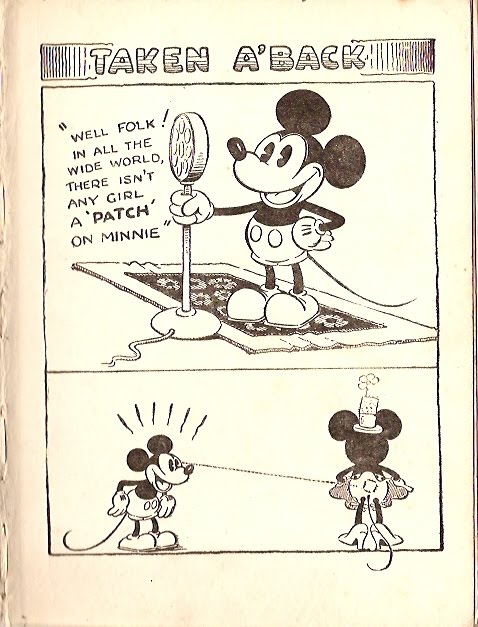
The artist on this, and most of the other comics pages in MMA, is Wilfred Haughton, best known as the artist of the highly acclaimed cover illustrations of Britain's Mickey Mouse Weekly onwards from its inception in 1936 till circa 1940. Haughton had been working on Dean's MM Annuals prior to his assignment to the MMW project. The bulk of the first MMA consists of such gag-a-page comics. Below follows a sampling of my favorite ones or those which I find interesting for various reasons:


I find the above gag noteworthy for two reasons. First, the side-line inclusion of a secondary humour element in the monkey silently stealing Mickey's food in the second panel is remarkable. Furthermore, producing a gag about women's fear of mice personified in Minnie's such fear is, on one had, ironic since she is, after all, an andromorphized mouse, and, on the other had, significant in showing the degree of internalizing the andromorph nature of Minnie (and Mickey).
The below gag is interesting in its inclusion of proper human beings into Mickey's world, which is out of line with Disney comics in general:
For my taste, I personally find the two below gags some of the funniest in this annual:


Unfortunately, MMA also includes some rather distasteful gags as well:
Even if the majority of the gag-comics in the first MMA can be assumed to be the work of Haughton, there were clearly more than one artist working on the comics in this publication. Below is a sample with markedly different and far more cruder graphic style:
In addition to gag-a-page comics, the first MMA also includes several gags in the format of non-panelized illustrations accompanied with text. The below one is interesting because it features Minnie's "papa", which we never see or even hear about in US comics:

Several of these non-comics gag pages incorporate illustrations from the US Mickey Mouse Book, such as the below one (see the post on MMB from Nov. 22, 2008 on this blog for a comparison with its original US edition):

The first MMA ends with this advertisement:


However, in addition to the first one at the very beginning, there are three more color plates throughout the annual: